
Patent Granted: The Future of Pressure Sensing Is Sewn, Not Soldered
The USPTO has granted Applied Sensor Co US Patent 12,612,720 for embroidered textile pressure sensors. Here is what it covers and why it matters for OEMs.
US Patent 12,612,720 · Company News · June 12, 2026
The USPTO has awarded Applied Sensor Co US Patent 12,612,720 for our pressure-sensitive textile sensing platform, invented by our founder, Dr. Raymond King. It protects an idea we have built the company around: the next generation of pressure sensing will not be bolted onto products. It will be sewn into them.
You can read the full patent on Google Patents: https://patents.google.com/patent/US12612720B1/en
What the patent covers
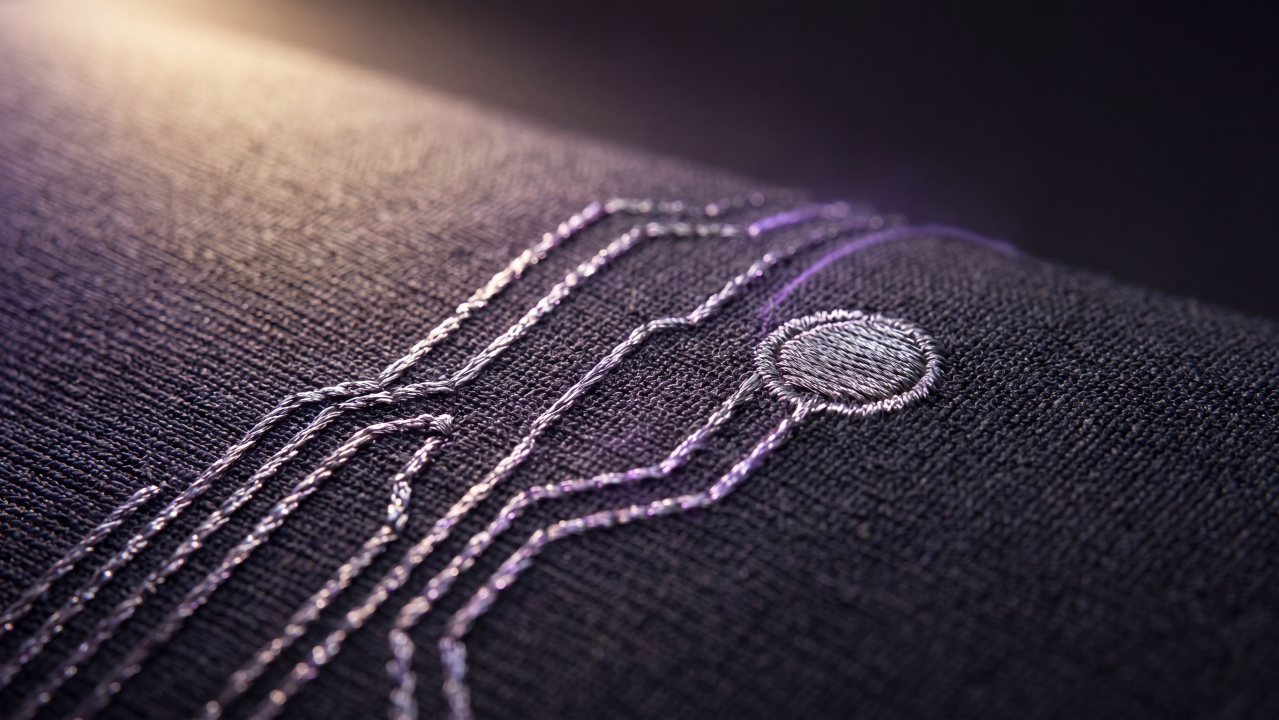
At the core is a multilayer sensor architecture in which conductive elements are combined through embroidery into the fabric itself. The sensing pads, signal traces, electrical interconnects, and structural assembly all form in a single unified construction.
The stitching does more than hold the sensor together. The stitch design is the sensor.
Why this matters
Smart textiles have been ten years away for about ten years. The reason is manufacturing. Every prior approach required exotic custom fibers, specialized materials, or production processes that fall apart at volume. Promising demos never became shippable products because the economics never worked.
This architecture solves that. Embroidery is a mature, proven industrial process. The sensor is formed on equipment that already exists, with materials that already have supply chains, at price points that survive contact with a real bill of materials.
What this means for product teams
- Scales on proven industrial infrastructure. No new fab, no custom material supply chain, no science project between prototype and production.
- Engineered to spec, not adapted to it. Pad geometry, density, sensitivity, and dynamic range are all design parameters within the platform. One architecture, configured to your product.
- A step-change in unit economics. Versus previous-generation textile sensing, this is the difference between a demo and a shippable SKU.
Where it applies
The applications are everywhere pressure meets a surface:
- Sleep and bed occupancy monitoring
- Eldercare
- Smart flooring and foot-traffic analytics
- Wearables
- Prosthetics
- Inventory systems
Because the platform senses physical presence and pressure, with no cameras and no microphones, it fits settings where privacy matters most, like bedrooms and care environments.
Built by a team that ships
This is not a research paper. Applied Sensor Co designs and manufactures in Woodinville, WA, and the same team behind this patent ships consumer products today, including the SlumberTek bed-presence sensor and the TrampleTek Blue smart mat. Dr. King previously led early EMG research at Meta that influenced their CTRL-Labs acquisition. We know what it takes to move sensing from lab bench to production line.
For OEMs and product teams
The patented platform is available for white-label integration and licensing. If you have been looking for a sensing layer that is durable, invisible to the end user, and economical at volume, without inventing a supply chain to get there, we should talk.
Reach us at oem@asc.com or visit our OEM and white-label page.
Soft surfaces are the next interface. We hold the patent on making them practical to build.
— Applied Sensor Co